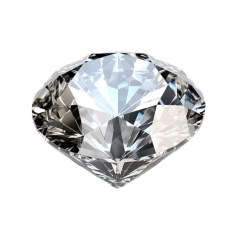
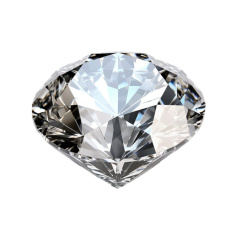
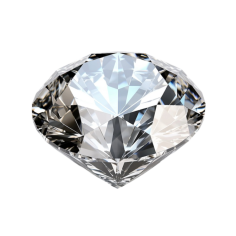
Unlike mined diamonds, lab-grown diamonds are created in a sustainable manner, without harming the environment or causing ethical controversies, making them an increasingly desirable and conscious alternative in the world of gemstones.
How are lab-grown diamonds made? – HPHT and CVD methods
The process of creating lab-grown diamonds is a technological marvel that mimics or improves on nature.
1. HPHT method – High Pressure High Temperature
This method recreates the conditions prevailing deep within the Earth's mantle. A small fragment of diamond (known as a grain) is placed in a specialized press surrounded by pure graphite (carbon). It is then subjected to extremely high pressure (over 5 GPa) and temperature (approx. 1500°C). Under these conditions, the carbon atoms crystallize on the grain, forming a larger, raw diamond with a regular structure.
2. CVD method – Chemical Vapor Deposition
The CVD method resembles atomic "3D printing." A thin slice of diamond is placed in a vacuum chamber, into which a mixture of carbon-rich gases (e.g., methane) is introduced. Under the influence of microwaves, the gases break down and the carbon atoms are deposited layer by layer on the diamond, enlarging it. This process allows for precise control of crystal growth and the production of diamonds of very high purity.
Both methods allow for the production of diamonds with a hardness of 10 on the Mohs scale, which means they are just as durable and scratch-resistant as natural diamonds.
4C – the same, highest rating standard
Both lab-grown and natural diamonds are graded according to the same rigorous 4Cs criteria established by the Gemological Institute of America (GIA):
- Carat (Weight) – the weight of a stone, expressed in carats (e.g., 1 ct = 0.2 g).
- Cut – the quality of the cut, which determines the brilliance and sparkle of the stone.
- Clarity – the degree to which a stone is free from internal blemishes (inclusions).
- Color – the shade of a diamond, ranging from perfectly colorless (D) to slightly yellowish.
Thanks to certification by leading institutes such as the GIA and IGI, every lab-grown diamond has a unique identification number laser-engraved on its edge, which confirms its authenticity, specifications, and origin, ensuring complete transparency throughout the purchasing process.
Can a lab-grown diamond be distinguished from a natural one?
Not with the naked eye. Even for an experienced jeweler or gemologist, it is impossible to distinguish between a lab-grown diamond and a natural diamond without specialized equipment. Both stones have identical appearance and properties. Differences can only be detected in advanced gemological laboratories, which analyze subtle crystal growth patterns and trace elements.
Why are lab-grown diamonds a conscious and wise choice?
Lab-grown diamonds are an excellent choice for those seeking beauty, quality, and responsibility. Their key advantages include:
- Ethical origin: You can be 100% sure that your diamond was produced without violating human rights and is not a so-called "conflict diamond."
- Sustainable development: Their production consumes significantly less water and energy and does not require large-scale interference with ecosystems, unlike traditional mining.
- Exceptional value: Thanks to a more efficient production process, lab-grown diamonds are significantly more affordable than their natural counterparts of the same quality. This means that you can afford a larger or clearer stone for the same budget.
- Quality guarantee: Controlled conditions allow for the creation of diamonds with excellent parameters, which are confirmed by international certificates.
They are the perfect choice for engagement jewelry, earrings, bracelets, and necklaces, offering the same prestige and beauty as mined diamonds.
Invest in modernity and beauty
Laboratory-grown diamonds are the future of the jewelry market – conscious, transparent, and sustainable. Thanks to them, you can enjoy unique diamond jewelry that impresses with its brilliance, durability, and ethical origin. When you choose our products, you receive an authentic diamond created from the same carbon atoms, not as a result of exploiting the earth, but thanks to the power of human intellect – precisely and responsibly.
Order jewelry with lab-grown diamonds that combines modern technology, jewelry quality, and elegance without compromise.
Frequently Asked Questions
Is a lab-grown diamond a real diamond?
Yes—laboratory-grown diamonds have the same crystal structure, chemical composition, and physical properties as natural diamonds. A hardness of 10 on the Mohs scale, the same brilliance and sparkle. The only difference is in their origin: lab-grown diamonds are created using the HPHT or CVD method under controlled conditions, rather than as a result of millions of years of geological processes. To the naked eye—or even to a jeweler—it is impossible to distinguish them from natural diamonds without specialized laboratory equipment.
Why are lab-grown diamonds cheaper than natural ones?
The lower price is due to a more efficient production process—lab-grown diamonds do not require costly mining, transportation, or a long chain of intermediaries. This means that for the same budget, you can choose a stone with a larger carat weight or a higher clarity grade than you could with a natural diamond. The optical quality, hardness, and brilliance remain identical. This is an excellent solution for those who value beauty and quality without overpaying for the stone’s geological origin.
What certifications do the lab-grown diamonds at Mennica Skarbowa have?
Every lab-grown diamond available at Mennica Skarbowa is graded according to the same 4C criteria as natural diamonds and comes with a certificate from a reputable gemological laboratory—GIA or IGI. The certificate contains a unique identification number laser-engraved on the stone’s edge, which confirms its parameters and origin. The document is available in both paper and electronic formats.
Is a lab-grown diamond suitable for an engagement ring?
Yes—lab-grown diamonds are becoming an increasingly common and conscious choice for engagement rings. They offer the same brilliance, hardness, and durability as natural diamonds, and their origin is fully verified and ethical—in compliance with international standards. This is the choice for couples who value aesthetics, a modern approach to jewelry, and responsibility. Available in a wide range of specifications and price points in the Mennica Skarbowa collection.
How do the HPHT and CVD methods used to produce lab-grown diamonds differ?
The HPHT method replicates the natural conditions under which diamonds form—high temperature (approx. 1500°C) and pressure (over 5 GPa) cause carbon to crystallize onto a diamond substrate. The CVD method works differently: in a vacuum chamber, carbon-rich gases are deposited layer by layer onto a diamond substrate, allowing for precise control of crystal growth and the production of stones of very high clarity. Both methods produce diamonds with a hardness of 10 on the Mohs scale—the same as natural diamonds.












 (1)_LBMA.jpg)



 English
 German
 Ukrainian


 801 501 521