








 (1)_LBMA.jpg)



 English
 German
 Ukrainian

Your shopping cart
No products in the shopping cart

 801 501 521
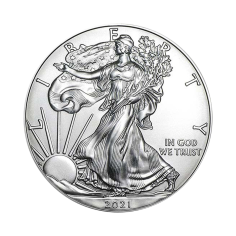
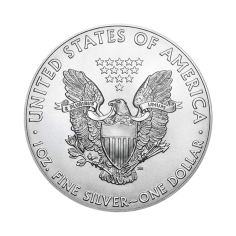
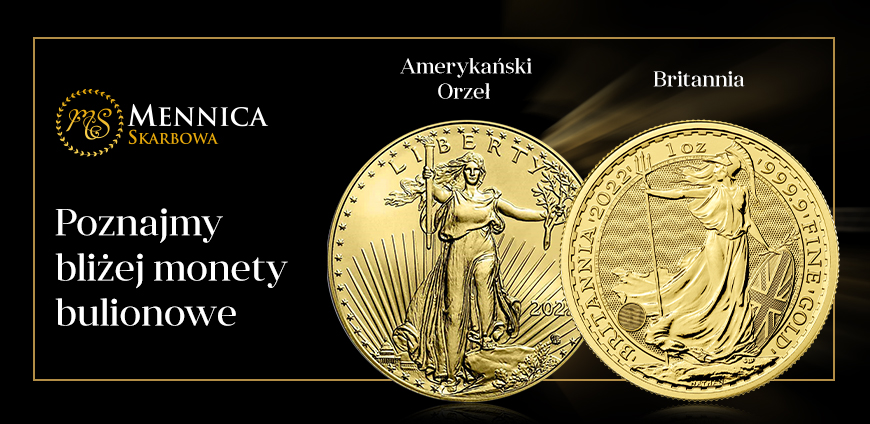
The American Eagle is undoubtedly the most popular bullion coin in the United States. To date, over 30 million have been minted! The quality of the coin is guaranteed by the United States Congress, which approved it in 1986.
The history of the American Eagle dates back to 1798, when the gold twenty-dollar coin known as the "Double Eagle" began to be minted. However, after 135 years, production was halted due to the devaluation of the dollar against gold. The current version has been issued by the US Mint since 1986. The US Mint decided to create competition for popular bullion coins such as the Canadian Maple Leaf and the Krugerrand.
The Double Eagle was a circulating coin, and the American Eagle is legal tender for the payment of public and private debts within the United States.
The coin is made of 22-carat gold, but that's not all. The coins also contain silver and copper alloys. The exact percentage composition is: gold - 91.67%, silver - 3%, copper - 5.33%. A one-ounce gold coin therefore has a total weight of 33.930 grams. The use of other metals makes the coins more resistant to damage and more difficult to counterfeit (it is difficult to obtain exactly the same alloy). It is also worth noting that the US government ensures that only gold from domestic deposits is used in the production of coins.
The American Eagle is available in several weight options. Of course, the corresponding denominations are arbitrary, as they do not correspond in any way to the gold used to mint them. The one-ounce coin has a denomination of $50, the 1/2 ounce coin is $25, the 1/4 ounce coin is $10, and the smallest coin, weighing 1/10 ounce of gold, is $5.
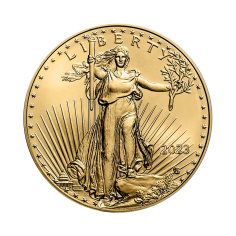
The coin's design has remained unchanged since 1986, when it was first issued. The obverse refers to coins minted between 1907 and 1933 and the design by Augustus Saint-Gaudens. It depicts Lady Liberty, the personification of freedom, walking with the attributes of peace: an olive branch and a torch. At her feet is the Capitol building, surrounded by stars representing the number of states.
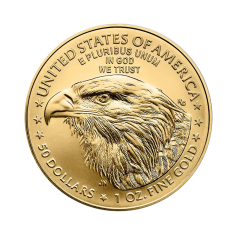
The reverse depicts an eagle landing in its nest, surrounded by American maxims in the spirit of the Declaration of Independence: "In God We Trust" and "E pluribus unum" (Out of many, one).
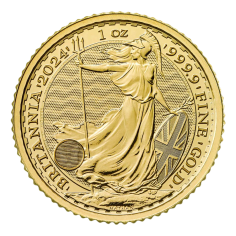
The Britannia is also one of the most beautiful and well-known bullion coins. The Royal Mint began issuing coins featuring the Roman personification of the Kingdom in 1987. Since then, it has had the status of a gold bullion coin.
Britannia also has legal tender status in the United Kingdom and a government guarantee of weight and purity, which makes it highly trusted by investors.
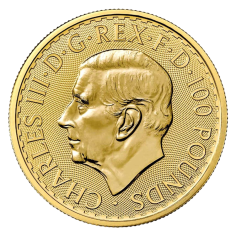
The coin is currently issued in gold, silver, and platinum, in many different denominations. Of course, the first was the gold Britannia – 22-carat gold with a fineness of 917 and an admixture of silver was used, and after 2013, 24-carat gold with a fineness of 999.9. Today, the following denominations are available: 1 ounce (100 pounds), 0.5 ounce (£50), 0.25 ounce (£25), 0.1 ounce (£10), 0.05 ounce (£5), 0.025 ounce (50 pence), and 5 ounces (£500).
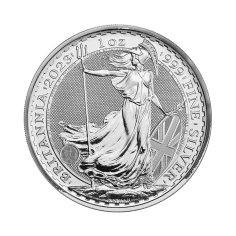
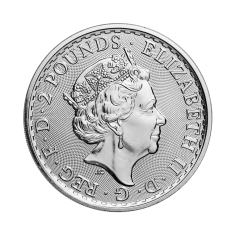
Silver coins appeared in 1997. Until 2012, a fineness of 958 was used, and later 999. The denominations are 1 ounce (2 pounds), 0.5 ounce (1 pound), 0.25 ounce (50 pence), 0.1 ounce (20 pence), 0.05 ounce (10 pence), and 5 ounces (10 pounds).
The platinum coin has been on the market for the shortest time. It was first minted in 2018. Only two denominations are available – 1 ounce (£100) and 1/10 ounce (£10).
An interesting fact is that the diameter and thickness of the coin changed during production. Initially, it was 32.69 mm and 2.79 mm, respectively, but one issue in 2013 was significantly larger and thinner – 38.61 mm and 1.80 mm, respectively. Since 2014, the original dimensions have been restored.
The image of the Roman personification of the Kingdom, known since the days of the Roman Empire, was first used by the Royal Mint on official British coins in 1672.
The obverse of the coin depicts Britannia. It is worth noting that each year the coin is minted, the design changes slightly, which also gives the coin collector's value. The name of the coin, the year of issue, and the gold content are placed around it.
The reverse side – which comes as no surprise in the case of coins from the Royal Mint – features an image of Queen Elizabeth by Ian Rank-Broadley, accompanied by the inscription: "Elizabeth II, by the Grace of God, Defender of the Faith." The denomination is also displayed there.