








 (1)_LBMA.jpg)



 English
 German
 Ukrainian

Your shopping cart
No products in the shopping cart

 801 501 521
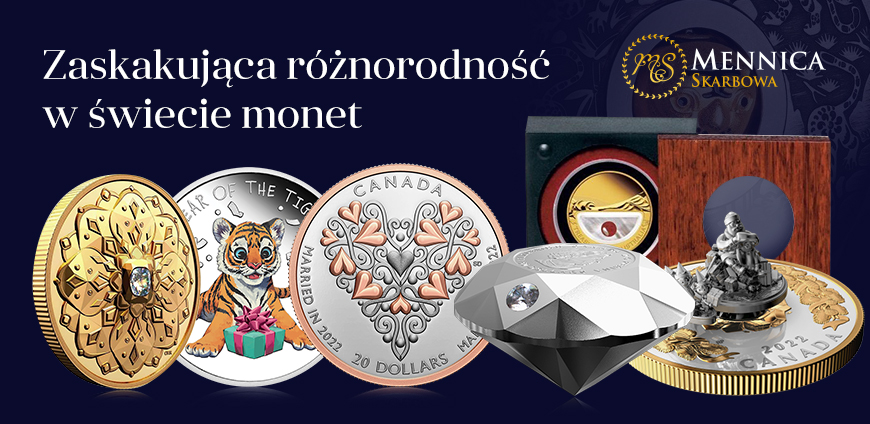
Let's start with the fact that coins do not always have to be disc-shaped. In order to surprise us, mints around the world prepare specimens referring to various circumstances, and this is how, for example, Christmas stars or coins in the shape of Santa Claus or Easter eggs are created. Take, for example, the silver Jurassic Park: Tyrannosaurus Rex coin – why show an image of a dinosaur when you can simply create a dinosaur?
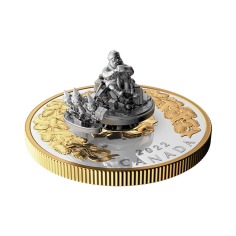
However, the unusual shape is not the only surprising feature. Mints are going a step further by producing three-dimensional collector coins or coins containing three-dimensional elements. The Royal Canadian Mint has created a silver coin that literally reflects the hat of the Royal Canadian Mounted Police, a symbol recognized around the world. What's more, a special gold plating technique has made it possible to perfectly replicate the felt from which the headgear is made, while the use of bronze gold has created an imitation of a leather strap.
Another example is the silver coin "Christmas Gifts, " which features 3D elements as well as a unique mechanism that sets them in motion. When you tilt the coin, the hard-working elves begin to spin around Santa Claus.
Sometimes, such a movable 3D element is placed in the center of the coin, allowing us to admire it from both the reverse and the obverse. An example of this is a coin from the Australian Perth Mint, which features an hourglass with particles imitating flowing sand in its center, or another offering from this mint – a silver coin celebrating the Year of the Tiger, in which a small tiger plated with 18-karat gold rotates around its axis.
And finally, a fully 3D example: a coin reflecting the shape of a Forevermark Black Label round-cut diamond, featuring a real 0.2-carat diamond.
A silver or gold coin – but does it always have to be such a clear-cut choice? There are many silver coins available on the market whose elements are selectively gold-plated to achieve a unique visual effect. Take, for example, the rose gold plating on the "Happy Wedding" coin or the decorations on the Voyageur Dollar.
Gold and silver on coins are not the only visible colors of this precious metal. More and more often, we encounter colorful coins featuring multicolored designs. Let's take the example of the colored "Baby Tiger" coin from the Year of the Tiger 2022 or the "Dreaming Down Under" series, also prepared by the Australian mint, The Perth Mint. These are five colored coins depicting drawings of sleeping small animals, such as koalas and Tasmanian devils.
However, coloring is not the only way to diversify coins. Sometimes precious stones, amber, pearls, or diamonds are placed in them. Here are a few examples:
Finally, let's mention another element that mints surprise us with. It is the weight, and thus the size of the coin. Suffice it to mention the aforementioned Voyageur coin, made of as much as a kilogram of silver, with a diameter of 10 cm.
Although they are far from truly record-breaking collector coins, such as the 100-kilogram Canadian Maple Leaf coin or the 1-ton Australian Kangaroo coin.
As we can see, coins can be truly surprising. Each one will be a unique addition to any collection, as well as an investment. Collectible items are also ideal as gifts – with such a variety of designs and themes, you are sure to find something that suits the interests of the recipient.
