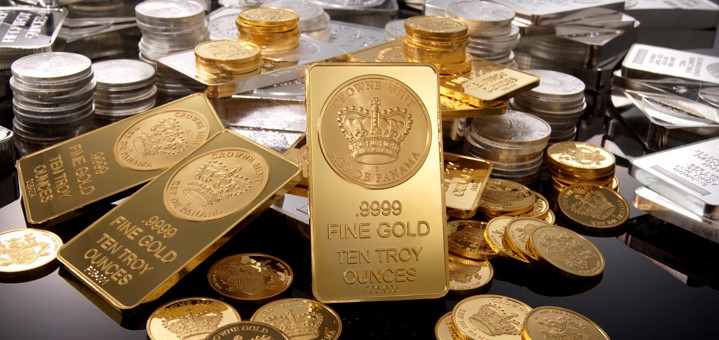
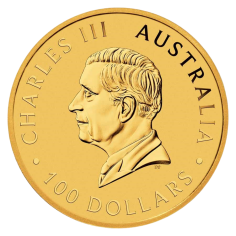
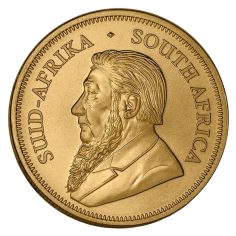
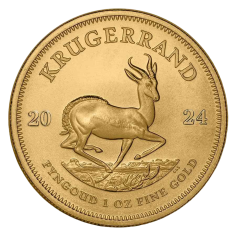
Investors around the world know how to take advantage of relatively low prices on the gold market. The latest report from the World Gold Council shows that in the third quarter of this year, demand for bars and coins rose by 28% compared to the same period last year. Almost neck and neck with retail investors, central banks bought 22% more gold for their vaults.
A LEAP IN THE INVESTMENT MARKET
After a period of temporary crisis, investor sentiment once again began to favor purchases. Undoubtedly, the biggest incentive was relatively low prices, which in the case of long-term investments are a natural signal to replenish resources. Fear also provided significant support for demand. This time, however, investor anxiety was not due to the geopolitical situation, but to losses in emerging markets and concerns about the world's major currencies.
Thanks to these developments, demand for bars and coins reached 298.1 tons, up 28% compared to the third quarter of last year and 20% compared to the previous quarter.
The largest increase was observed in the largest market, China. Compared to both the previous year and the previous quarter, the jump was 25%. Thus, demand reached 86.5 tons. Interestingly, the average for the last 5 years is 65 tons.
The European market also achieved good results, with demand reaching 51.1 tons, which is 10% more than last year. More than half of this gold was purchased in Germany (28.4 tons).
CENTRAL BANKS CONTINUE PURCHASES
In the case of central banks, the positive trend has been continuing for several quarters now. We have already written about the motives behind the intensive expansion of gold in several previous articles. First and foremost, it is about becoming as independent as possible from the dollar, and thus from the US economy, whose enormous debt bodes ill for the future. Russia and China have the largest share in creating the trend of moving away from the dollar. Interestingly, only the former has been included in the WGC statistics. However, the lack of official purchases by China does not mean that the Middle Kingdom is not expanding its reserves. There are many indications that this is rather a strategy of keeping purchases secret, which you can read more about here.
Russia, on the other hand, has adopted a completely opposite policy and regularly reports on further sales of US government bonds and additions to its gold reserves. Admittedly, it has something to boast about, as it has ranked first on the WGC list for another quarter in a row. This time, its reserves increased by 92.2 tons. It should be emphasized that this is a 22% increase compared to the same period last year. What is more, low gold prices have finally allowed President Putin to achieve his honorable goal of returning to the situation of the Soviet era, when Moscow's vaults held over 2,000 tons of gold. Currently, Russia has 2,036.2 tons, which accounts for 16.9% of total reserves.
Turkey, Kazakhstan, and India followed Russia, purchasing 18.5 tons, 13.4 tons, and 13.7 tons, respectively. It is also worth noting that several new banks have joined the group of buyers in recent months, including the National Bank of Poland. After years of silence, Poland increased its holdings by 13.7 tons to 116.7 tons. Although this is still very little compared to the countries at the top of the list, the Polish bank cannot be denied its momentum, as its reserves increased by 750%. Hungary has taken similar action, increasing its reserves from 3.1 t to 31.5 t (+916%).
In total, the central bank sector purchased 148.4 tons, which is 22% less than last year*. This is the best result since 2015.
* Not all banks that made purchases are listed in the article.
Based on Gold Demand Trends Q3 2018












 (1)_LBMA.jpg)



 English
 German
 Ukrainian


 801 501 521