











 (1)_LBMA.jpg)



 English
 German
 Ukrainian

Your shopping cart
No products in the shopping cart

 801 501 521
- Author of the entry: Mennica Skarbowa
- Date of entry:
Last week saw a slight increase in gold prices, closing at $1,256.60 per ounce. The changes in gold prices are primarily driven by the Fed and the comments of its members, which have been very diverse in recent days. Will the announced interest rate hikes in the US have to wait?
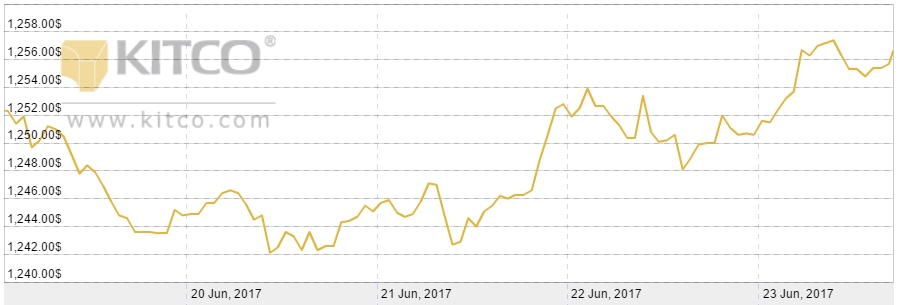
Last Monday, gold prices fell to their lowest level in five weeks. This was due to an optimistic comment made by the head of the New York Fed. William Dudley said that although inflation in the US is at a fairly low level, he believes it should rise soon along with wages. And as the labor market improves, this should allow the Fed to continue gradually tightening US monetary policy.
In the wake of this comment, the price of an ounce of gold fell below the 100-day moving average and rebounded on the spot market only from the level of $1,244. Further declines were halted by uncertainty surrounding the start of talks on the terms of the United Kingdom's departure from the European Union.
Tuesday brought further declines to around $1,241 per ounce of gold (the lowest level since mid-May), still riding the wave of optimism expressed by the Fed, which had a positive impact on the dollar, weakening gold.
It was not until Wednesday that there was a rebound from a five-week low, which followed a drop in oil prices that severely weakened the stock markets and the dollar. On that day, the metal managed to break through to around $1,250 per ounce and clearly moved away from technical support at around $1,237/oz.
On both Wednesday and Thursday, the main factors encouraging investors to buy gold were the aforementioned sudden drop in oil prices and the steepest flattening of the US Treasury yield curve in nearly a decade.
Friday brought further strengthening of gold prices. The reasons for this can be found in global political uncertainty, a weaker dollar, and limited prospects for further interest rate hikes in the US. James Bullard of the St. Louis Fed expressed his doubts on this matter on Friday, stating that the Reserve should wait with further hikes until the 2% inflation target is actually achievable. Following these comments, the dollar recorded its biggest daily decline in three weeks, while gold strengthened significantly.
As a result, the week closed slightly up, with a result of $1,255.70/oz on the London Stock Exchange and $1,256.60/oz at the close of the Ocean Stock Exchange. In Poland, an ounce of gold cost approximately PLN 4,740 on Friday.
MW
Last Monday, gold prices fell to their lowest level in five weeks. This was due to an optimistic comment made by the head of the New York Fed. William Dudley said that although inflation in the US is at a fairly low level, he believes it should rise soon along with wages. And as the labor market improves, this should allow the Fed to continue gradually tightening US monetary policy.
In the wake of this comment, the price of an ounce of gold fell below the 100-day moving average and rebounded on the spot market only from the level of $1,244. Further declines were halted by uncertainty surrounding the start of talks on the terms of the United Kingdom's departure from the European Union.
Tuesday brought further declines to around $1,241 per ounce of gold (the lowest level since mid-May), still riding the wave of optimism expressed by the Fed, which had a positive impact on the dollar, weakening gold.
It was not until Wednesday that there was a rebound from a five-week low, which followed a drop in oil prices that severely weakened the stock markets and the dollar. On that day, the metal managed to break through to around $1,250 per ounce and clearly moved away from technical support at around $1,237/oz.
On both Wednesday and Thursday, the main factors encouraging investors to buy gold were the aforementioned sudden drop in oil prices and the steepest flattening of the US Treasury yield curve in nearly a decade.
Friday brought further strengthening of gold prices. The reasons for this can be found in global political uncertainty, a weaker dollar, and limited prospects for further interest rate hikes in the US. James Bullard of the St. Louis Fed expressed his doubts on this matter on Friday, stating that the Reserve should wait with further hikes until the 2% inflation target is actually achievable. Following these comments, the dollar recorded its biggest daily decline in three weeks, while gold strengthened significantly.
As a result, the week closed slightly up, with a result of $1,255.70/oz on the London Stock Exchange and $1,256.60/oz at the close of the Ocean Stock Exchange. In Poland, an ounce of gold cost approximately PLN 4,740 on Friday.
MW
