









 (1)_LBMA.jpg)



 English
 German
 Ukrainian

Your shopping cart
No products in the shopping cart

 801 501 521
- Author of the entry: Mennica Skarbowa
- Date of entry:
The past week was full of events eagerly awaited by investors, but there were also some completely new ones, such as the severing of diplomatic relations with Qatar by several countries in the Middle East. However, most investors' eyes were primarily focused on the testimony of the former FBI director regarding the alleged Russian influence on the US presidential election. There was also anticipation surrounding the parliamentary elections in the UK, which were expected to strengthen Prime Minister May's position in the Brexit negotiations. As it turned out, Comey's testimony came as no surprise, and Theresa May lost support instead of gaining it. The stronger dollar sent the price of gold down, and the week ended at USD 1,266.40/oz.
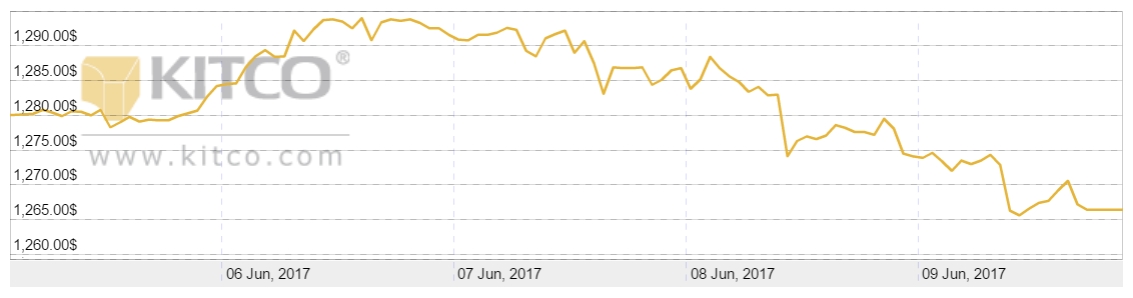
Last Monday, gold prices stabilized at around $1,280 per ounce, after soaring over the weekend on the back of reports of weak US employment figures.
On Tuesday, gold prices accelerated slightly and rose to their highest level in seven months, while the dollar fell to its weakest level in the same period. The price of gold climbed towards the psychological barrier of $1,300 per ounce, reaching $1,294.34 per ounce on the spot market that day.
On Wednesday, gold began to lose ground slightly, and the dollar index rose 0.1 percent when it turned out that the former FBI director's written statement did not contain many surprises. James Comey testified, as expected, that Donald Trump asked him to end the investigation into former security adviser Michael Flynn and his involvement in Russia's alleged attempts to influence the outcome of the recent US presidential election.
In Europe, investors' attention was focused on the British parliamentary elections. The ruling Conservative Party, which wanted to strengthen its position ahead of the Brexit negotiations, might not have secured a majority.
On Thursday, the dollar strengthened slightly again, while the euro weakened after the ECB lowered its inflation forecasts and admitted that a reduction in the scale of its bond-buying program had not even been discussed during the meeting. Gold prices fell to $1,277.95 per ounce on Thursday, but it was on Friday, after the not-so-successful elections for British Prime Minister Theresa May, that the metal saw its biggest drop of 1%.
Due to the strengthening of the dollar, for the first time since the beginning of May, gold ended the week with a loss. At the close of trading in London, an ounce of gold cost USD 1,266.55, and across the Atlantic, USD 1,266.40. In Poland, the week saw fluctuations in the range of PLN 4,726-4,833/oz and ended at its lower level.
Last Monday, gold prices stabilized at around $1,280 per ounce, after soaring over the weekend on the back of reports of weak US employment figures.
On Tuesday, gold prices accelerated slightly and rose to their highest level in seven months, while the dollar fell to its weakest level in the same period. The price of gold climbed towards the psychological barrier of $1,300 per ounce, reaching $1,294.34 per ounce on the spot market that day.
On Wednesday, gold began to lose ground slightly, and the dollar index rose 0.1 percent when it turned out that the former FBI director's written statement did not contain many surprises. James Comey testified, as expected, that Donald Trump asked him to end the investigation into former security adviser Michael Flynn and his involvement in Russia's alleged attempts to influence the outcome of the recent US presidential election.
In Europe, investors' attention was focused on the British parliamentary elections. The ruling Conservative Party, which wanted to strengthen its position ahead of the Brexit negotiations, might not have secured a majority.
On Thursday, the dollar strengthened slightly again, while the euro weakened after the ECB lowered its inflation forecasts and admitted that a reduction in the scale of its bond-buying program had not even been discussed during the meeting. Gold prices fell to $1,277.95 per ounce on Thursday, but it was on Friday, after the not-so-successful elections for British Prime Minister Theresa May, that the metal saw its biggest drop of 1%.
Due to the strengthening of the dollar, for the first time since the beginning of May, gold ended the week with a loss. At the close of trading in London, an ounce of gold cost USD 1,266.55, and across the Atlantic, USD 1,266.40. In Poland, the week saw fluctuations in the range of PLN 4,726-4,833/oz and ended at its lower level.
