









 (1)_LBMA.jpg)



 English
 German
 Ukrainian

Your shopping cart
No products in the shopping cart

 801 501 521
- Author of the entry: Mennica Skarbowa
- Date of entry:

You've heard it many times, but when it comes to diamonds, size (or rather weight, since diamonds are measured in carats rather than size) is really of secondary importance. Contrary to popular belief, what determines the value of a diamond is the quality of the cut and the color. The type of cut and the clarity of the stone are also important.
CUT QUALITY
The cut determines the sparkle, which is why the quality of the cut is so important. The more perfect and proportional the cut, the more the stone sparkles, as it reflects more light. Diamonds with a poor or mediocre cut reflect little light, which is why they appear dull. Diamonds with a good cut give a nice effect, and the most beautiful ones are those with a very good and perfect cut. Unfortunately, they are very expensive.
Information about the quality of the cut is rarely provided by jewelers. However, information about their weight, color, and clarity is commonly provided.
COLOR
Color, or rather the lack thereof, is the second most important factor determining the value of a diamond. Diamond colors are designated by letters of the alphabet. The most expensive diamonds are marked with the letter D, and the cheapest with the letter Z. The closer to Z, the more yellow the diamond is. We choose those in the range from H to D (or from I or J to D). The most beautiful diamonds are colorless, which is why they look best when set in white gold or platinum. Yellow gold can give them an undesirable warm tone.
There are also diamonds with so-called fancy colors. They have a natural color, and the more intense the color, the more expensive the diamond. They can come in a variety of colors. Usually, these are warm colors such as yellow, orange, or brown, but there are also pink, green, blue, and purple ones. There are also natural black diamonds, which differ from the others in that they do not sparkle and do not transmit light.
WEIGHT
The larger the diamond, the higher the price, of course, but in the case of diamonds commonly used in jewelry, the price increases relatively proportionally to its weight. The weight of diamonds is measured in carats (ct). A round diamond weighing 0.25 ct has a diameter of approx. 4.1 mm, one weighing 1 ct has a diameter of 6.4 mm, and one weighing 2 ct has a diameter of 8.1 mm, so there is no need to go crazy. Since the price of a diamond increases significantly for full and half values, it is worth choosing a slightly smaller one (e.g., 0.9 ct instead of 1 ct). No one will notice the difference, but you will see the difference in price.
CLARITY
Most diamonds are not perfectly clear. They contain impurities, cracks, and structural imperfections. The clearer the diamond, the more valuable it is. Without going into detail, you are interested in diamonds with the following designations: FL or IF (the most expensive), VVS-1 and VVS-2 (still very expensive), VS-1 and VS-2 (slightly cheaper), SI-1 and SI-2 (cheaper, and the so-called inclusions are not visible without a magnifying glass anyway).
TYPE OF CUT
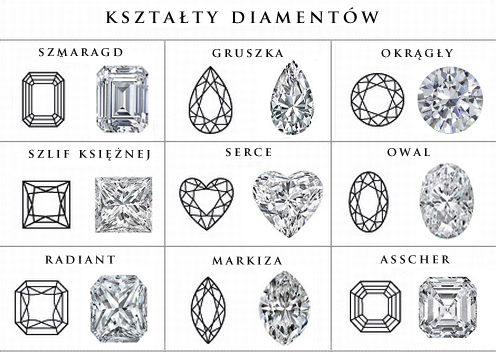
The type of cut is also important. There are nine basic cuts. If we take nine diamonds of the same weight, cut quality, color, and clarity, the most expensive will always be the round brilliant cut diamond. Diamonds with pear (teardrop), heart, marquise, or oval cuts will be cheaper. The cheapest will be those with an Asscher, radiant, emerald, and princess cut.
So you see that although the weight of a diamond matters, size is not the most important factor affecting its value. If you like large stones, by choosing the right shape, color, and clarity, you can have a larger stone for a lower price. And if you are buying jewelry not only as an ornament, but also as a security (for investment purposes), choose one with diamonds with better parameters. In the event of a possibleWhen sold, its value will be higher than jewelry purchased at the same price, perhaps more beautiful, with cheaper diamonds.
