











 (1)_LBMA.jpg)



 English
 German
 Ukrainian

Your shopping cart
No products in the shopping cart

 801 501 521
- Author of the entry: Mennica Skarbowa
- Date of entry:
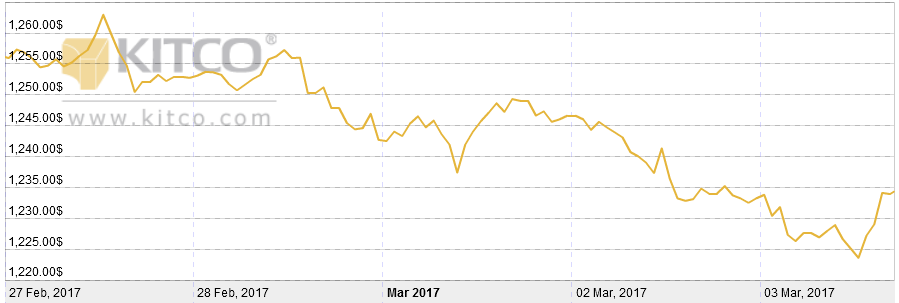
Last week was mainly spent waiting for investors. First, for President Donald Trump's speech to the US Congress on Tuesday, and then for Fed Chair Janet Yellen's statement on Friday. In both cases, it turned out that gold faces a considerable challenge in the form of an expected interest rate hike in the US. And precisely because of its growing likelihood, gold ended last week with a loss of almost 2%.
Monday started favorably for the precious metal, with spot gold prices reaching $1,262.80 per ounce, the highest level since mid-November. This was partly due to comments by the US president on the need to increase defense spending and continuing uncertainty surrounding the upcoming elections in the Netherlands, France, and Germany. However, the metal failed to stay above the 200-day moving average of $1,260.74 per ounce and began a series of declines.
In the first half of the week, investors refrained from making any decisive moves as they awaited Donald Trump's speech scheduled for Tuesday afternoon. In his speech, the US president was to outline his planned changes to taxes and tariffs, infrastructure spending, and foreign policy.
However, there were also voices of reason among analysts, emphasizing that the price movement of gold following the president's speech, regardless of its direction, would be rather short-lived. After all, the president's ideas will still require legislative work, congressional approval, and implementation.
Contrary to expectations, Trump did not announce any details of the planned reforms, so investors turned their attention to the Fed, whose chair was due to outline plans for US monetary policy in a few days' time.
February ended with a 3.7% increase in gold prices (according to London fixing), but on a weekly basis, the metal continued to decline. This was undoubtedly due to the strongest dollar in seven weeks, which was helped by the head of the New York Fed. William Dudley, one of the most influential American central bankers, stated that tightening monetary policy had become "much more attractive," and John Williams of San Francisco added that he saw no need to delay the next interest rate hike. The probability of a rate hike at the next meeting (as measured by Thomson Reuters) soared from 30% to 67.5% on that day.
On Wednesday, data on consumer market inflation was also published, which rose by 0.4% in January, the largest monthly jump in four years. In the face of such favorable data for the US economy, even information provided by GFMS on February gold imports to India, which rose by as much as 82% year-on-year, did not help the dollar-denominated gold price.
Thursday was also not kind to gold, with the metal experiencing its weakest session since December last year. US unemployment data released that day showed that the number of new claims for benefits is currently at its lowest level in 44 years. This information is extremely important for the Fed, whose next meeting is scheduled for March 14-15.
It is therefore not surprising that Janet Yellen confirmed on Friday that if inflation and unemployment data do not deteriorate, we can expect another interest rate hike in the middle of the month. Following Yellen's announcement and Donald Trump's lack of specifics, gold ended the week at $1,234.30.
On the Polish market, based on London fixings and the average dollar exchange rate according to the National Bank of Poland, the price of an ounce of gold fell by 1.9% last week and closed at PLN 5,023.
Marianna Wodzińska
Head of Trading
Mennica Skarbowa S.A.
